
The Breton: A Humble Striped Shirt & French Fashion Icon
If France were required to choose a national uniform, it wouldn’t be the beret (though Hollywood insists on putting one atop every fictional Parisian), it would be the Breton, aka la marinière, the humble blue-and-white striped shirt that is a French fashion staple.
I spend 4-5 months a year on the French Riviera, and it’s a daily staple. Throw it on with a pair of white jeans or shorts, and I suddenly feel effortlessly chic and qualified to slurp oysters and sip chablis with confidence.
Disclosure: This post contains affiliate links, and I may earn a tiny commission if you click and purchase through them, at no extra cost to you! Thank you for helping me do what I love.
But the stripes are not just for seaside soujourns. From Paris to Monaco, Brittany to the Alps, the famous French tee is a wardrobe essential you can find in high-end boutiques, vintage stores, and even flea markets around the country.
The Stripey Story
The marinière could possibly be fashion’s greatest glow-up. Its transformation from a utilitarian naval garment into a global emblem of French cool is nothing short of a phenomenon.
It entered fashion history on March 27, 1858, when the French Navy decreed that sailors must wear a white cotton knit with alternating indigo stripes, a pattern that made them easier to spot if they fell overboard.
The white stripes were to be twice the height of the blue ones, and lore says there were 21 stripes total, to denote each of Napoleon’s victories. Oh! La! La!
But no one, least of all the sailors wearing them, could possibly have imagined these striped work shirts would one day strut down runways in world capitals and be recreated and worn by fashion and cultural icons through the decades.
Why is it called The Breton?
The marinière’s spiritual birthplace is Brittany, a large and beautiful peninsula jutting into the Atlantic Ocean in the Northwest corner of France, bordered by the English Channel to the north and the Bay of Biscay to the south. From Paris, you could easily do a day trip or an overnight.
The region is known for its gorgeous, rugged coastline, medieval towns, and absolutely delicious crêpes, and Breton refers to a person from or things related to Brittany. Eh, Voila!
Striped knitwear was common among fishermen there, and had been for generations. The shirts were part of the landscape, as characteristic as the region’s granite cliffs and salted butter.
Part of its power lies in its simplicity: anyone can wear it. Slip it on, and you’re instantly easy-breezy sophisticated, whether you’re wandering through Paris or dining alfresco in Nice, and fashion houses caught on to it.
Who Wore it Best?


By the early 20th century, the marinière had caught the eye of artists who recognized, long before fashion houses did, its subversive charm. No one championed it more passionately than Pablo Picasso, who wore stripes as easily as he wielded a paintbrush.
Look at photographs of the Spanish artist, and you’ll see him sporting his beloved Breton shirt. Jean Cocteau followed, then Jean Seberg, who turned the marinière into a cinematic symbol of insouciant cool in Breathless.
James Dean often wore a Breton shirt on and off the screen, and Andy Warhol was another devotee. And have you ever seen a French mime NOT wearing stripes?
But it took Coco Chanel to transform the marinière from countercultural quirk into mainstream fashion revolution. Vacationing in the seaside resort of Deauville in 1917, Chanel admired the easy, practical clothing worn by local sailors and decided to adapt the look for her clients.

She introduced a nautical collection around 1917, inspired by the French sailors’ uniforms. It was radical in an era still dominated by strict tailoring for women. Chanel reframed the French striped shirt as a symbol of modern freedom for women, and the marinière became stylish without losing its coastal soul. #GirlPower
Decades later, Jean Paul Gaultier would elevate the shirt to near-religious status. The French fashion designer not only wore the stripes but incorporated them into his haute couture collections, splashed it across perfume bottles, and turned the humble sailor stripe into an emblem of French identity.
Under Gaultier’s influence, the marinière became inextricably linked to France and Frenchness. Even Taylor Swift has worn a version.
Where to get your Breton?
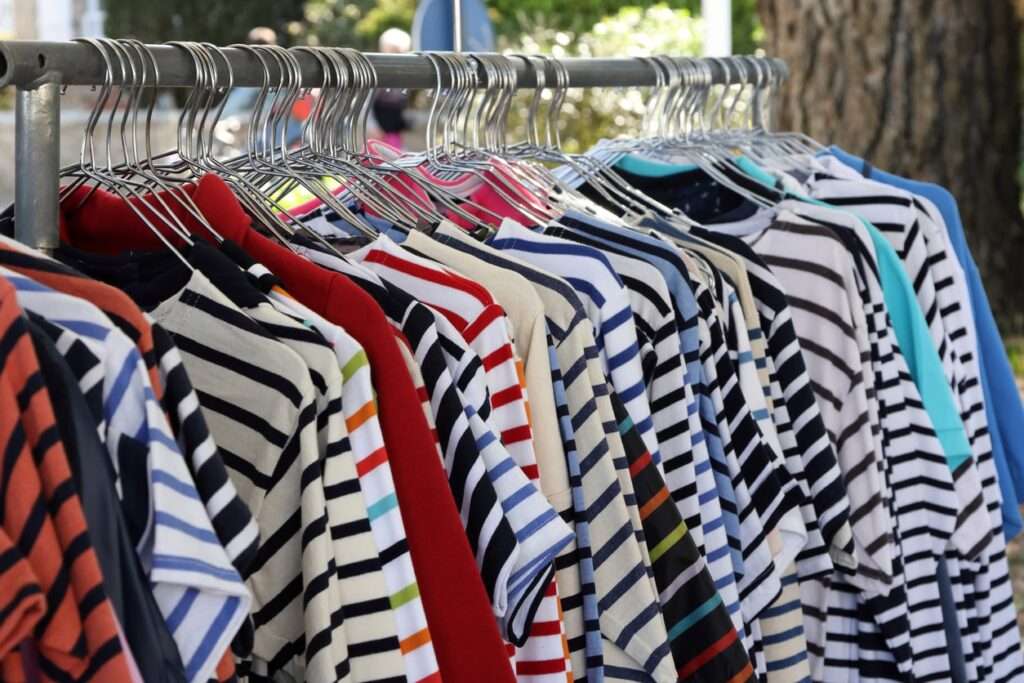
Today, the marinière remains irresistibly appealing, and versions and nods to it come in, excuse the pun, all stripes. You’ll find it in red, multi-colors, on dresses, v-necks, sweaters, etc. Designers reinterpret it every year, but the classic versions (boat neck, 3/4 sleebes) from Saint James, Armor-Lux, and Petit Bateau honor the original uncomplicated and elegant naval spirit.
For travelers, the cotton marinière is a staple that survives hotel sink washes, seaside picnics, and baguette crumbs. Even better, the shirt carries a kind of French je ne sais quoi. To wear a marinière is to wear a little piece of France.
It’s practical. It’s chic. And most importantly, it proves that sometimes the most stylish things in life begin not with a quest for glamour, but with the simple need to keep someone from disappearing into the sea.
As the wife of a sailor, I’m grateful for that.
Find more French Riviera Travel Inspiration